I am passionate about helping to increase “Science Capital” for all
Since my PhD in the 1990s I have delighted in connecting with non-experts to share the joy of what science can reveal and to nurture curiosity. I aim to boost what is sometimes called “Science Capital“, a combination of: (1) science we know about, (2) science we’ve experienced doing, (3) who we know related to science and (4) how scientifically we think. The more “Science Capital” we have the more scientifically literate, and likely to consider a STEM (Science Technology Engineering and Mathematics) career, we are.
Paid Professional Science Communication Experience
Since January 2025 I have been a professional Science Communicator.
Freelance Science Workshops with Hands-on-Science
In Jun 2025 I was delighted to join the team at Hands-on-Science educational company as a Freelance presenter delivering a range of fun and informative science workshops in primary schools.
I was pleased to receive this lovely feedback from a school where I worked in Oct 2025:
“Thank you to your presenter for such a wonderful day. The children were enthralled from start to finish. The day was just as brilliant as we had hoped it would be.”
– Mr J Budden – Leader for Science, Somerville Primary School, Birmingham.
Infectious Diseases Talks and Workshops in Schools and beyond…
In schools I have begun to design and deliver my own talks and workshops about science careers, healthy bodies and infectious diseases for up to GCSE-level students.
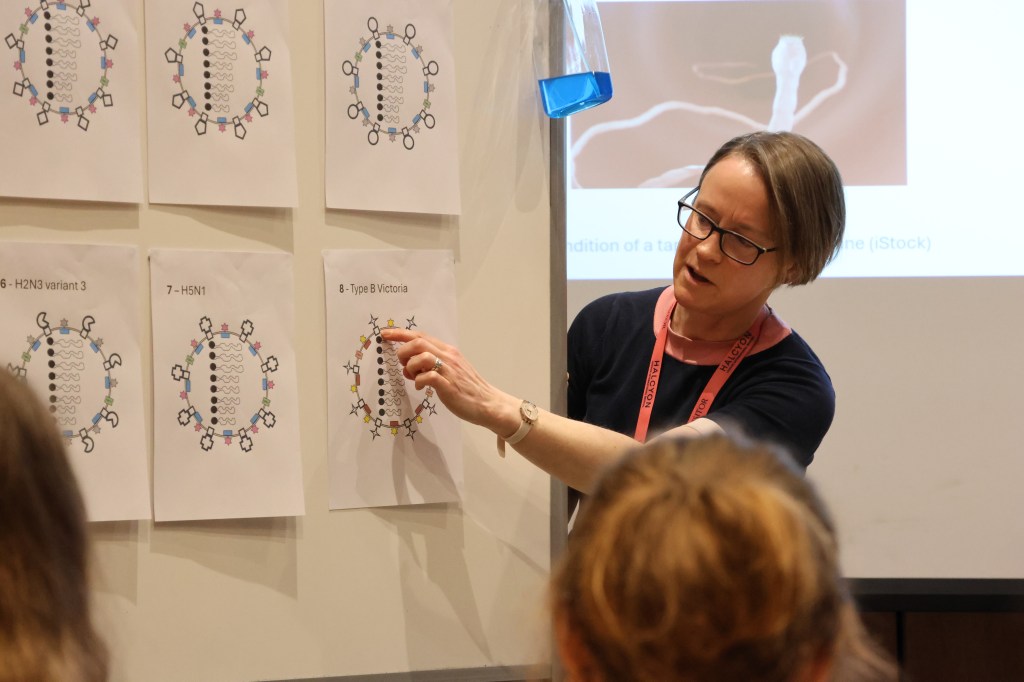
At “Beamish – The Living Museum of the North” over the weekend of April 25th-26th 2026 I was paid to present at their “Roll up your sleeve” event.
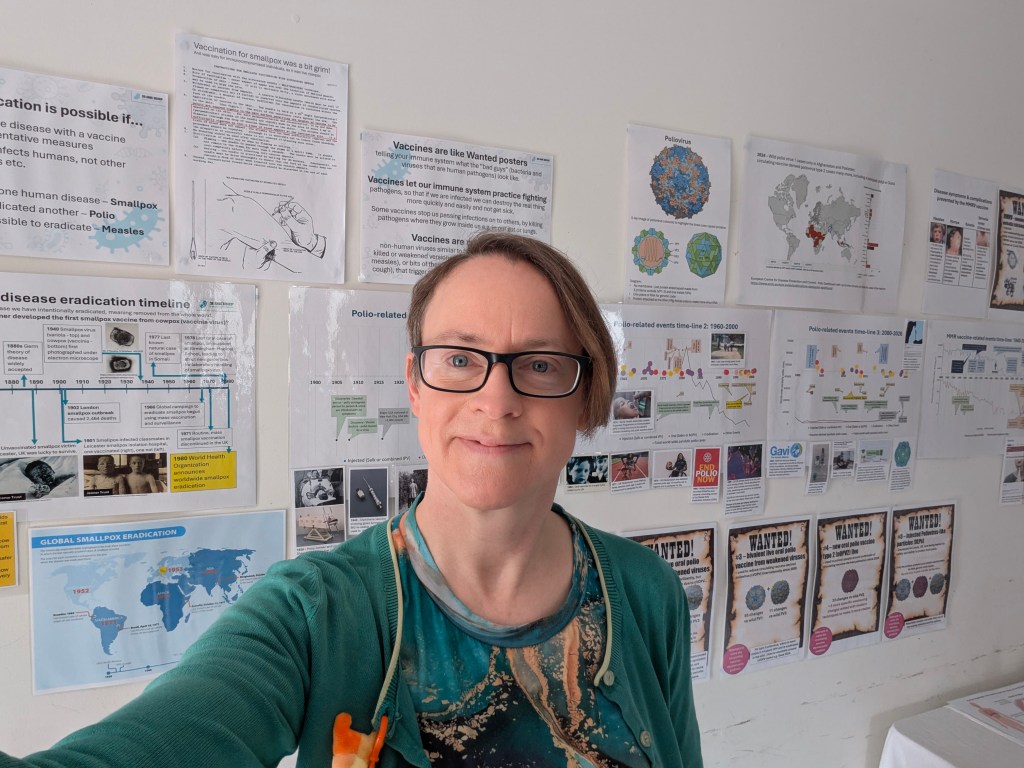
I took 109 museum visitors through a whistle-stop tour of disease eradication history and science, from smallpox that has been eradicated, to polio that we are close to eradicating and measles, which it’s theoretically possible to eradicate.
Each person to whom I spoke added a dot for the year of their birth, which ranged from 1945 to 2026, to a timeline showing milestones for polio eradication. That way we could place them in the history and see who had visited my display.
Public Health Family Workshops in Libraries
In December 2025, in collaboration with the education charity Ignite!, I was awarded a Nottingham City Council Public Health Community Champions grant to run three different “Healthy Bodies and Vaccine Knowledge” family workshops in two libraries in lower income areas of Nottingham.
These were run on Saturdays once a month in The Meadows and Bulwell libraries from Feb to May 2026. Launched as part of the Festival of Science and Curiosity, they attracted a total of 75 different people (32 adults and 43 children).
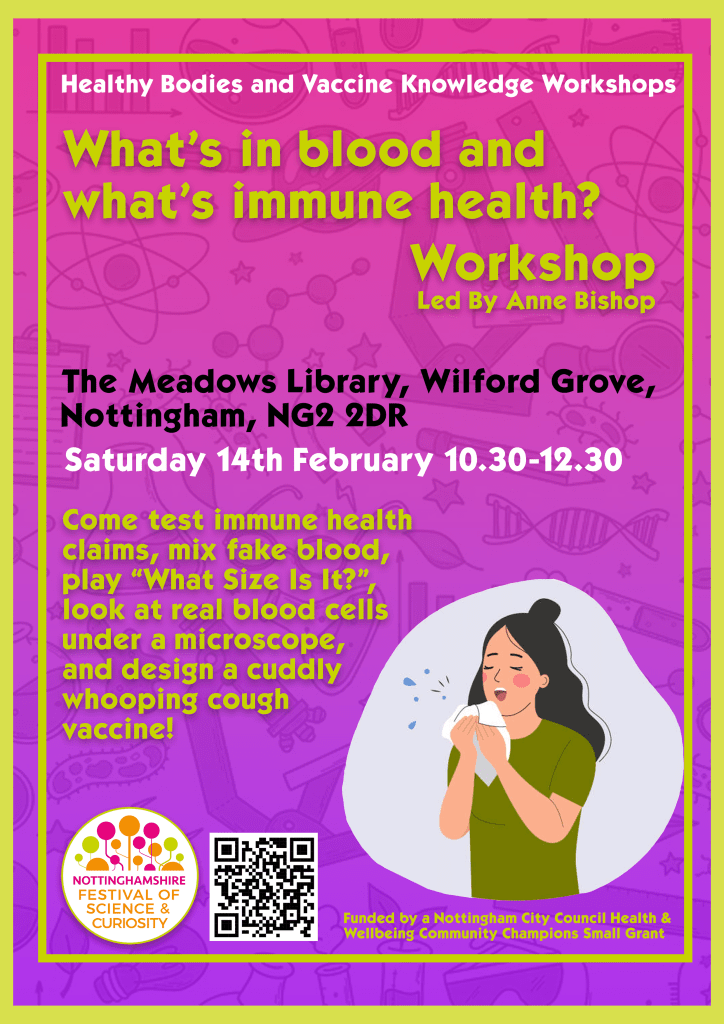
Resources linked to the workshops can be found here.
A survey filled by 36 respondents told us that 28/36 found the content “useful for supporting others in their health decisions” and 27/36 said that something in the workshop seemed “helpful for making decisions” about their own health.
When asked what was “The best thing they learnt” responses included:
“How to protect people and you if you’re sick in public places”
“Difference between viruses and bacteria”
and my favourite
“About what is what”
25/36 of survey respondents gave the workshops 5/5 for “Enjoyment” and “Interest” and nobody gave less than 3. Seven families returned for multiple sessions, which was a good sign of their enjoyment.
What survey respondents “enjoyed most” included specific comments, such as “Learning about vaccines for flu; The communication game”, and encouraging general comments:
“Everything”
“All of it”
“My son was very happy”
Speaking to the power of inter-generational family workshops, one response said they most enjoyed:
“Working together with my kids”
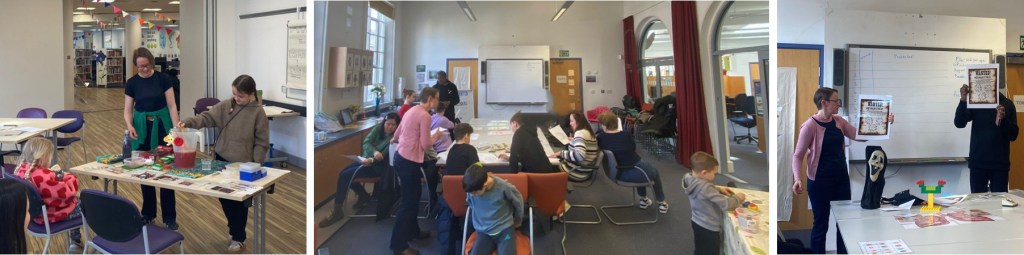
I note that participants granted permission for myself and Ignite! to publish these photographs.
Science Communication as a Volunteer
Whilst working as a research scientist or teacher in Higher Education I volunteered to speak to non-experts about science. That was sometimes families, school children or older people.
Public Engagement with “Connecting Science” at the Wellcome Sanger Institute
While working as a post-doctoral researcher at the Wellcome Sanger Institute in Cambridge I was also active with their amazing team of public engagement professionals within “Connecting Science“. So much so, that I became a “Science Engagement Champion“.
Schools Engagement at the Wellcome Sanger Institute
I spoke at 9 primary school “Meet a Scientist” career chats, given 9 short research talks for secondary school groups (2022-2024) and hosted two classes at the July 2024 “Schools Conference”.
A colleague shadowing my talk for A-level students said:
“Observing your talk has given me lots of good ideas…I liked how it covered a lot of science and technical terms, but you always took time to explain what everything meant, which made a complex subject easier to understand.
When you talked about how exciting new discoveries are, I could hear it in your voice, which was fantastic.”
Talking with older community members via the Wellcome Sanger Institute
In Oct 2023 Connecting Science linked me up with charity “Cambridgeshire Older People’s Enterprise” (COPE) and their “Talking Together” program, aimed at tackling loneliness and supporting lifelong learning.
This was a sheer joy, and has led me to want to work more with older members of the community.
I designed and wrote support materials that were mailed to participants, then facilitated 6 x 45min discussions via a group telephone call with a dozen people older people. We covered the basics of infectious diseases, vaccines, anti-microbial medicines and diagnostic tests, with a focus on polio and COVID-19 as examples.
“The warmth, sense of humour and information you shared really came through. Clearly, the participants were interested and involved.”
said Deborah Katznelson, chairperson of COPE
STEM Ambassador
If you’re wanting to visit schools to run workshops, train teachers or chat about science careers, do sign up as a STEM Ambassador. You get online training courses on safeguarding and engagement basics and they will facilitate your Disclosure and Barring Service (DBS) check, as well as linking you with local schools wanting volunteers. I signed up on 2022 and have been delighted with the network.
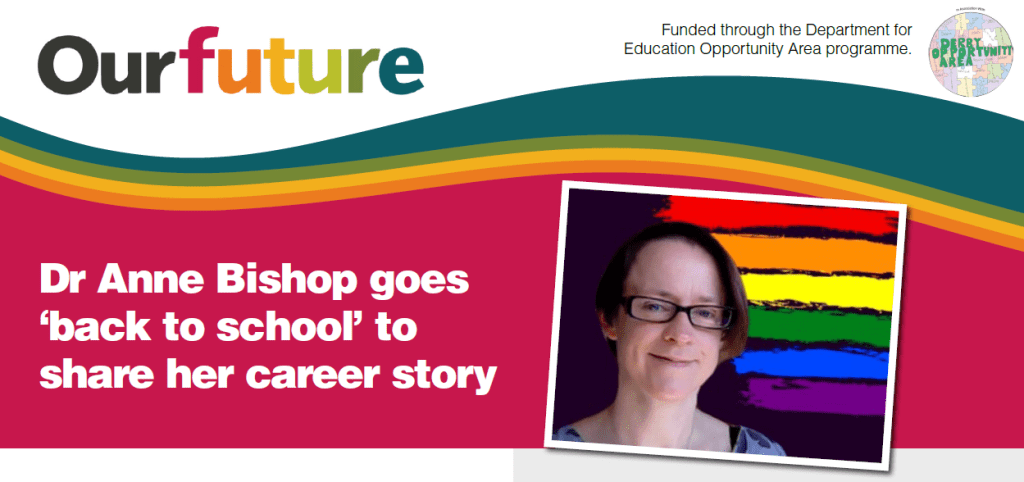
Through the STEM Ambassador Hub I was able to work with charity “Inspiring the Future” and “Learn by Design” education specialists to deliver 10 workshops in 9 different schools (2 online and 8 in-person) focused on women in science careers (2022 to 2024).

Here I am chatting online with school children about my research at the Wellcome Sanger Institute on International Day of Women and Girls in Science 2023.
I wrote a case-study in support of continued funding for education charity “Inspiring the Future”.
Combining my engagement in the Midlands and that hosted by the Wellcome Sanger Institute in Cambridge, with the STEM Ambassadors since 2021 I have achieved…
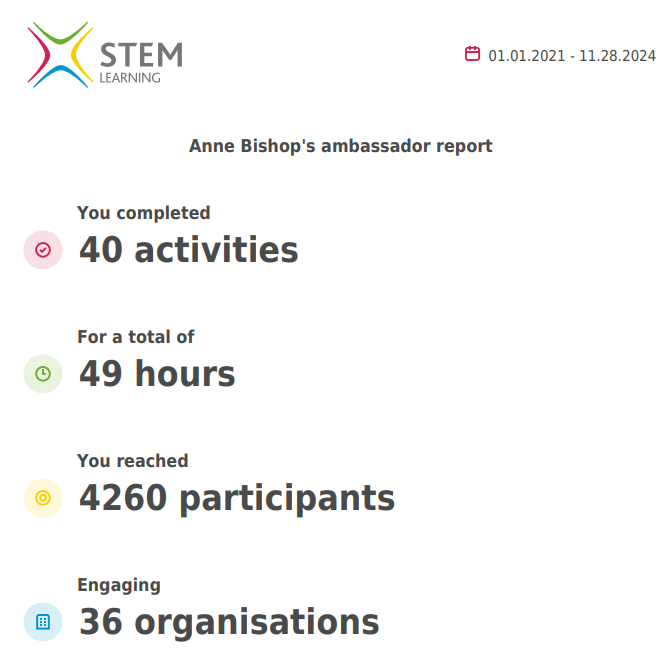
Note that the East Midlands STEM Ambassador Hub online STEM Elves competition 2023 had an audience of over 2000 school children so I “reached” a lot of kids with that one event.
Communicating Biology at the University of Nottingham
I was employed as a Teaching Associate at the University of Nottingham from Sept 2016-Dec 2019. As well as loving my role as a teacher, making the students squirm and appreciate good sanitation as I described the life-cycles of gruesome parasites, I sought out many chances to communicate a biology concepts to the wider public.
I worked along-side the widening participation team (who brought students from schools underrepresented in higher education on-site) and a range of colleagues within Life Sciences and the Chemistry department, doing pond-dipping, vaccine and immunology-related activities, extracted DNA from fruit and looking at arm evolution using the Life Sciences skeleton collection.
I was particularly delighted to join a team representing the University at the prestigious Royal Society Summer Science Exhibition in London (pictured), to work with Immunologists to design and deliver activities at a University family event “Wonder” and extract DNA from fruit with “looked after children”.
Open this tab to see more details of activities I was involved with at the University of Nottingham…
Royal Society Exhibition “Super-materials against Super-bugs” (July 2019) with the teams of Morgan Alexander, Professor of Biomedical Surfaces, Paul Williams, Professor of Molecular Microbiology and Kim Hardie, Professor of Medicine and Health Sciences.
Part of a team delivering DNA extractions at Schools Science Fair with the Chemistry department (May 2019).
Co-designed, delivered and evaluated “Elemental Immunity” family activities at “Wonder” science fair with Prof. Luisa Martinez-Pomares’ team (June 2019)
Flu vaccination activity at Family Discovery Day (June 2018) – co-designed and hosted on my own.
7 varied (arm anatomy, pond-dipping, DNA extractions, immunology and cell growth) school activities on campus, supported by the Widening Participation team and the inspiring Tom Hartman, for “looked after children” and other kids underrepresented in higher education.
Member of cross-department “Practitioners of Outreach Group”.
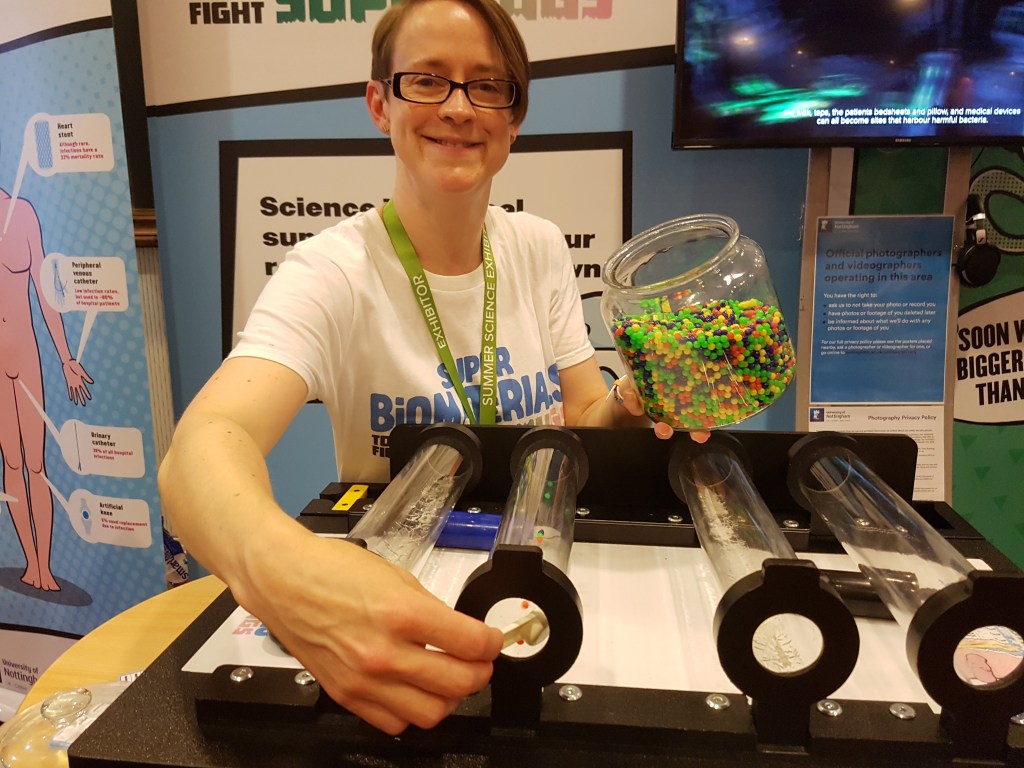
Here I am at the Royal Society Exhibition explaining sticky bacterial biofilms, how they block antibiotics from working properly and how researchers have made materials to prevent them, all using beads and tubes in fun races.
Science communication through poetry
Bringing together two of my loves, science and poetry, has been a joy for me. My own science-themed poems can be found here: https://annebishop.uk/2024/11/26/science-communication-through-poetry/.
Microbiology Continuing Professional Development for High School Teachers
I worked in the USA for 5 years where, along-side my laboratory cholera research, I volunteered as a Research Fellow for an NIH Science Education Partnership Award (held by Karina Meiri) at Tufts Medical School, Boston, USA, 2009-2010.
I was one of 3 microbiologists producing materials and running professional development for 6 biology teachers with whom we co-created a human disease-based “Bio-2” curriculum, which the teachers then delivered to school students.
This taught me a lot about giving and receiving feedback, which was part of every session, and learnt a great deal about clear communication from the teachers’ expertise.
First Encounters – a PhD Researcher in Residence
During my PhD I volunteered as a “Researcher in Residence“, working with a London school to design and deliver two lessons and a careers Q&A session for GCSE Biology students. The teacher I worked with got sick, so I delivered everything with support just from a teaching assistant. I was thrown-in at the deep end and I LOVED IT!
I had to strictly integrate with the curriculum! Their topic was blood and buffering, about which I was not very excited to be honest, but I worked with it. I had the students make solutions of albumin (the main blood protein) and study its pH buffering capacity, bringing along professional pipettes for them to try. We then looked at the chemistry of different amino acids and the gene sequence for human albumin, using online databases that scientists use each day.
I have taken every opportunity for both teaching (within Universities) and broad science engagement ever since, as you can see above.
Public Engagement-related Training – general and with a vaccination focus
I have higher education teacher training from the University of Nottingham and am an Associate Fellow of the Higher Education Academy.
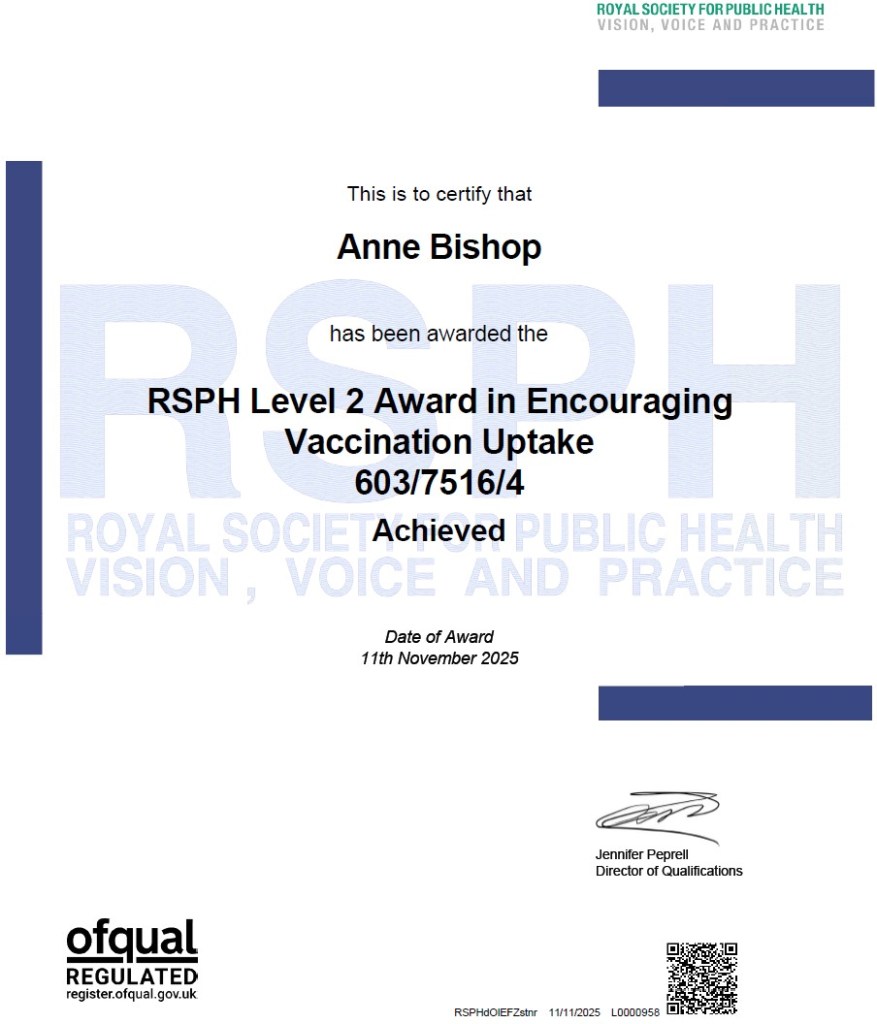
In November 2025 I was awarded a Royal Society for Public Health Level 2 award in “Encouraging Vaccination Uptake” after completing a one day course delivered by the Nottingham City council public health team and an examined and externally-audited post-course assessment.
On 9th July 2025 I attended a training day “The Empathetic Refutational Interview: improving vaccine conversations” to empower effective communication with vaccine hesitant people, hosted by the JitsuVAX project team.
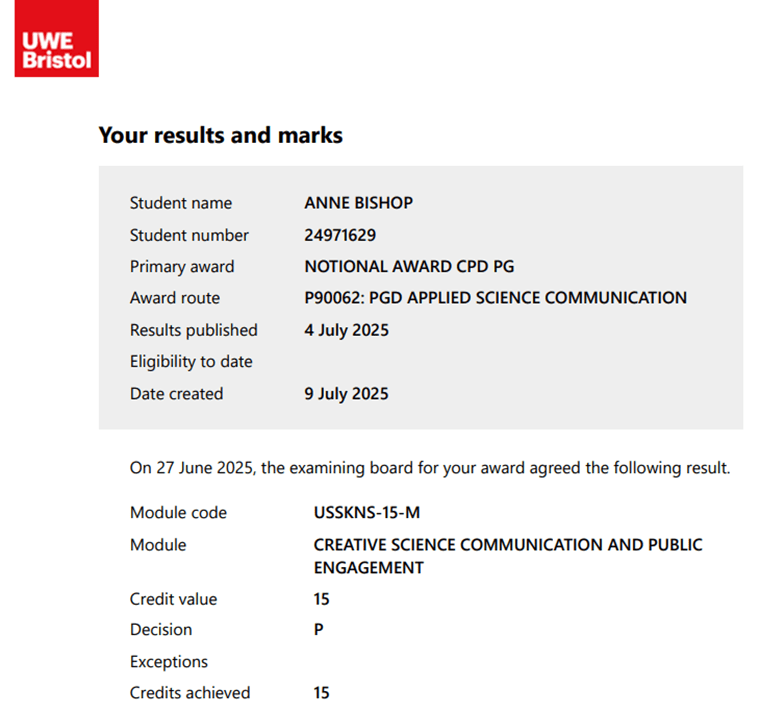
From Jan to April 2025 I completed and graduated from a “Creative science communication and public engagement” masters-level online continued professional development course at the University of the West of England.
After two months of learning, I successfully completed the two written assessments: (1) critical reflection; (2) a practice grant application.
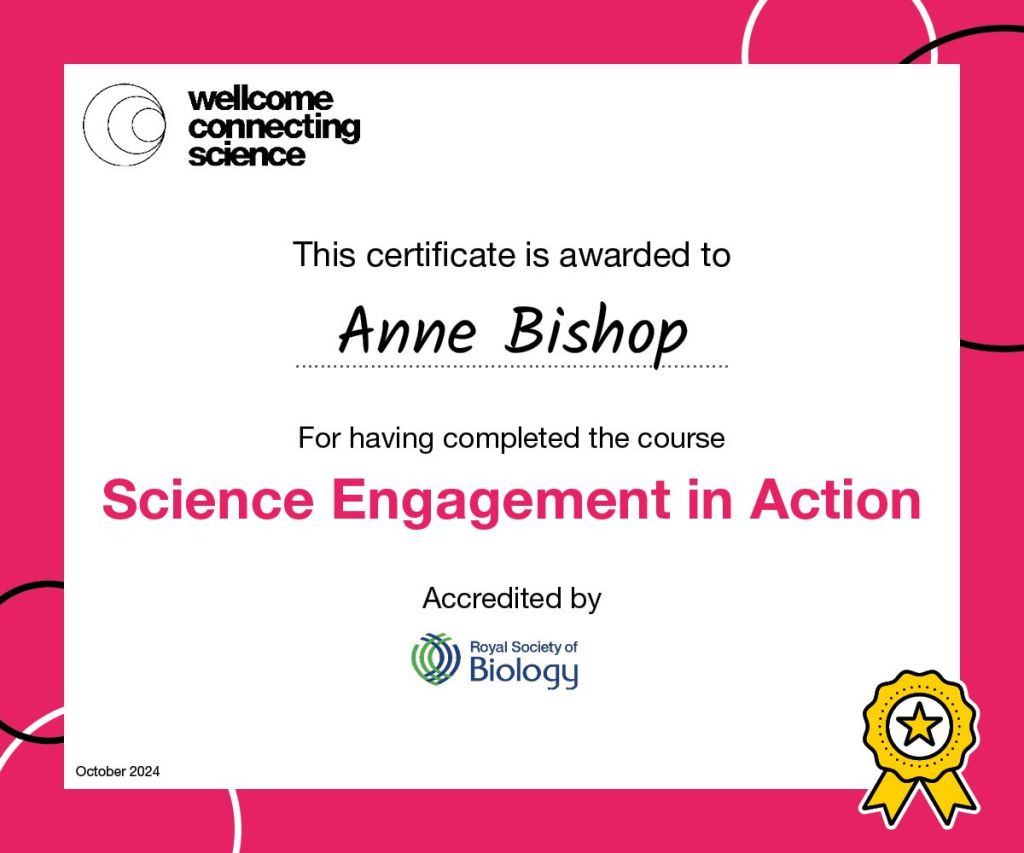
In Oct 2024 I completed the “Science Engagement in Action” training course at the Wellcome Sanger Institute, accredited by the Royal Society for Biology:
In 2024 I participated in a workshop “Engaging with neurodiverse and disabled children”, delivered by the Lightyear Foundation and hosted by “Connecting Science”, which gave us lots of great ideas about how to deliver STEM activities with more equitable access.
Science engagement training at “Nottingham Engaged: Global Research, Civic Impact” – University of Nottingham 2018; workshops attended:
- “Public Engagement 101”
- “Working with Schools”
- “Evaluating for Impact” delivered by members of the National Co-ordinating Centre for Public Engagement

