Although I am not a historian, I’ve become fascinated by the Office of National Statistics causes of death 1915-2015. Let’s take a look at what was killing folk in the UK up to and after when the polio vaccine was rolled-out in 1956.
UK top causes of death 1915-2015
In 2015 I was in my early 40s, and at that age there were 7.4 less deaths per 1000 people than if I’d lived 100 years earlier in 1915: age 40-44 1915 8.8 and 2015 1.4 deaths/1000.
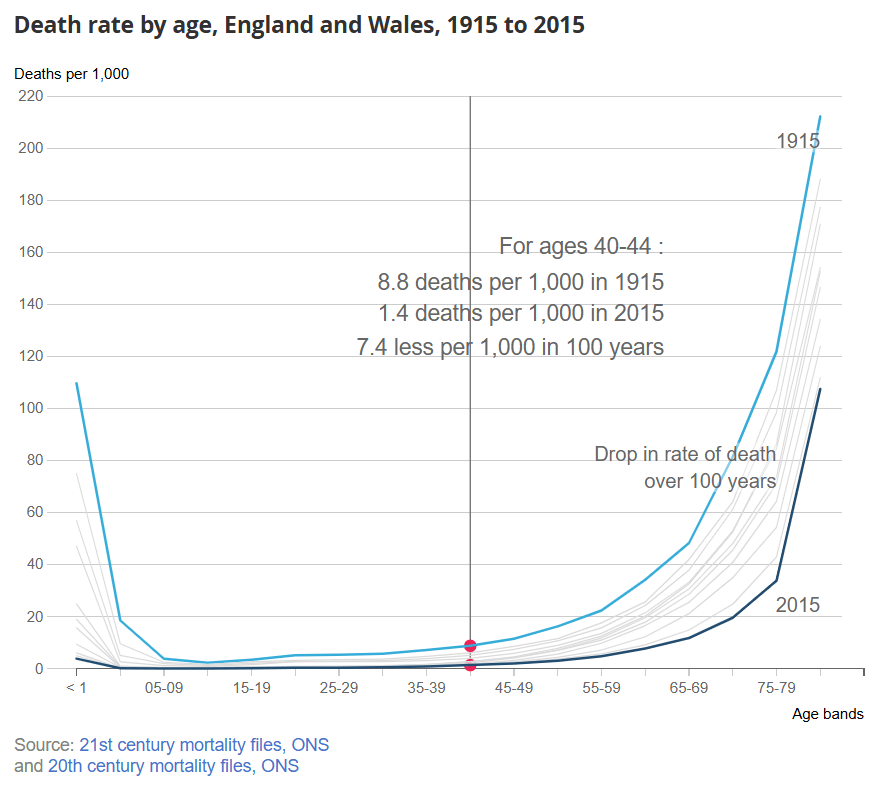
Even more dramatic is how many more people survive childhood and older age in 2015 than they did in 1915 – look at the difference between the light blue (1915) and dark blue (2015) curves at the high and low ends of the age range in the plot above.
If you were <1 year old there are over 100 more deaths per 1000 people at in 1915 than 2015, as seen highlighted in the plot here:
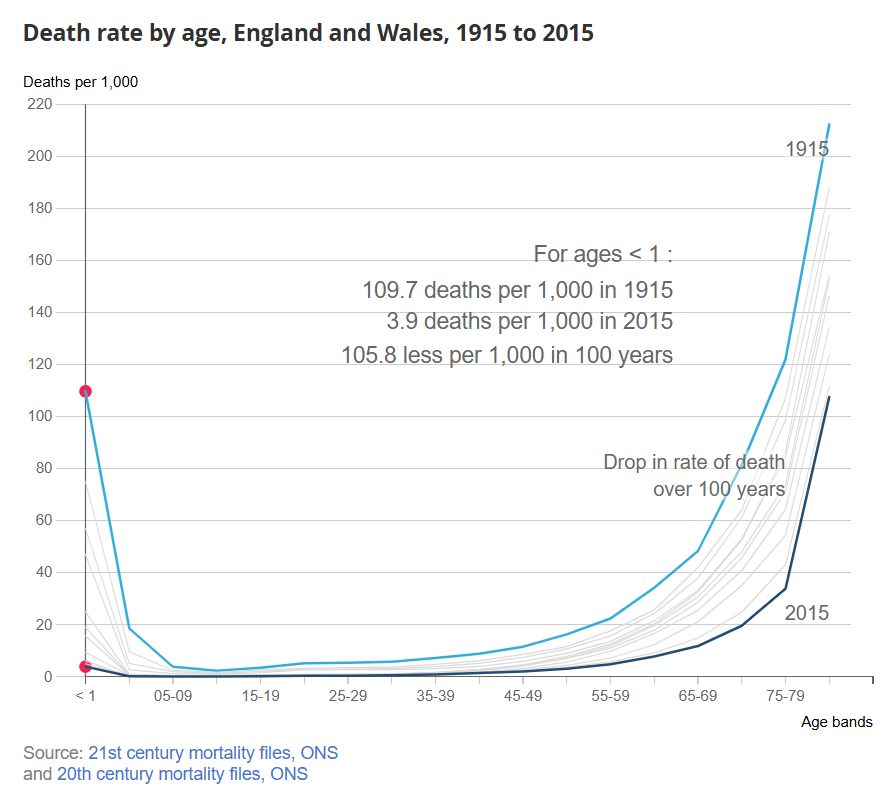
You can adjust the display of the data yourself with the UK Office of National Statistics interactive charts.
What causes the large number of deaths 1915 compared to 2015?
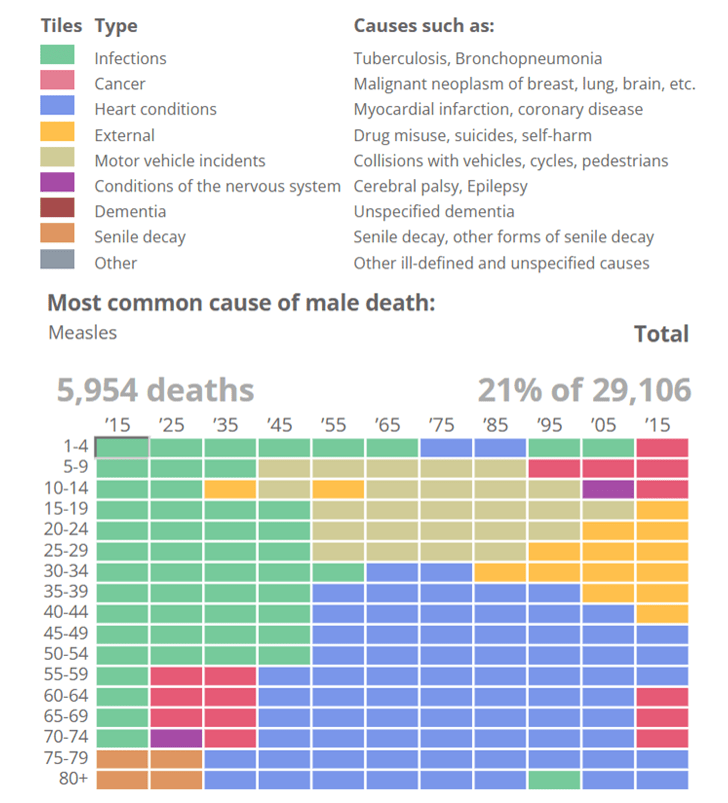
So what’s causing most of the large number of deaths in 1915? The plots below show just the top cause of death for each year by age for men or women in the UK, coloured by category.
Check out the bit in green, which is infection (for anyone who’s colour blind, all of the 1915 deaths except the over 75 age groups are due to infection).
“For those aged one to four, infections remained the leading cause of UK deaths right up until 2005 (with the exception of 1975 and 1985).”
Finally in 2015, infections are not the leading cause of death for any age group in the UK.
In 1915 measles is at the top for age 1-4 and diphtheria for age 4-9 (for which vaccines were rolled out in the UK in 1968 and 1942 respectively).
Here’s the plot of the top causes of death for males:
And there’s a similar pattern for females (see below), although more middle-aged women have heart-attacks in 1915 than did men (blue). Heart attacks become the major cause of death in men over 35 from 1955 onward. For women from 1955 cancer (pink), particularly in middle age and heart-attacks (blue), particularly in over 55s, become major causes of death. Deaths from motor vehicle accidents (beige) rise from 1955 for men and 1965 for women:
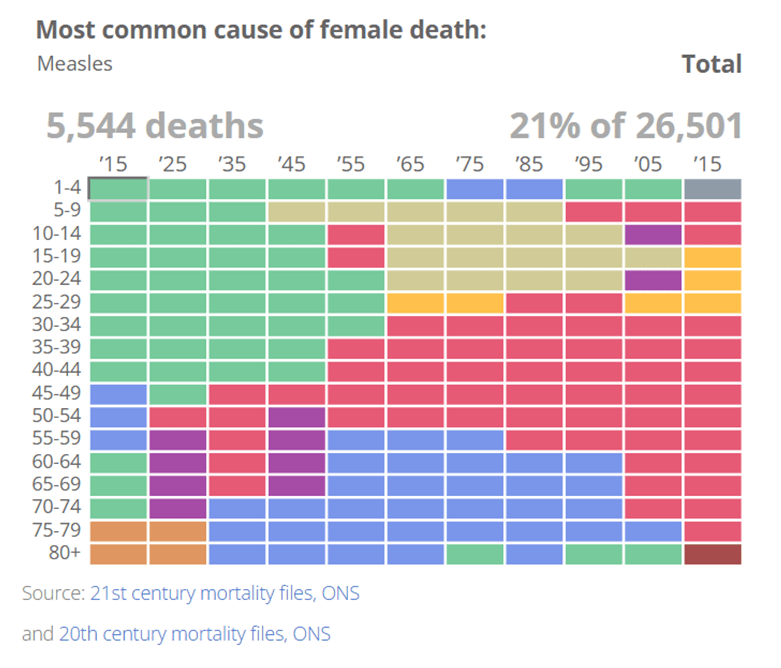
“Between 1915 and 1945, infections were generally the leading cause of death for young and middle-aged males and females.”
“There was a dramatic decline in the number of people dying from infectious diseases in the 20th century. Poliomyelitis (polio), diptheria, tetanus, whooping cough, measles, mumps and rubella were all virtually wiped out during the second half of the 20th century, after childhood immunisation was introduced.”
You can read about the vaccines made to prevent diphtheria, measles and polio in my blog “Vaccines tackling major childhood diseases, including polio“.
Measles used to be the top killer of kids
Measles was the top killer of small children in 1915 and measles still kills people today if vaccination rates get too low. So, let’s talk briefly about measles.
Measles is spread via droplets or in the air when an infected person breathes, sneezes or coughs.
For measles the short-term fears of death due to brain swelling or respiratory failure are accompanied by fears of long-term effects, including a general immune suppression for up to 3 years, so you can catch other infectious diseases more easily, and complications like encephalitis (brain swelling that can cause brain damage even if it’s not fatal) and irreversible blindness.
Before widespread vaccination was introduced, measles caused an estimated 2.6 million global deaths each year. And worldwide, measles is still a major cause of death.
In 2016 about 90,000 people died of measles world-wide, which is a huge reduction thanks to vaccines, but is still a vast number. On the plus side this was the first year on record when global measles deaths fell below 100,000 a year. We still have no cure for measles, but vaccines can prevent it.
Following these years of decline in measles cases, when vaccination dramatically reduced the number of deaths, in 2022 measles cases globally rose by 18%, and deaths by 43%, compared with 2021. During this time, worldwide vaccination coverage also declined to its lowest level since 2008. This is very worrying!
In the UK in 2024 we had 11,162 measles cases reported and 5 deaths due to the disease. So, there is still a lot to do in tackling this vaccine-preventable disease.
More measles vaccine and disease information is available at the Vaccines Knowledge Project pages.
Did polio cause many deaths?
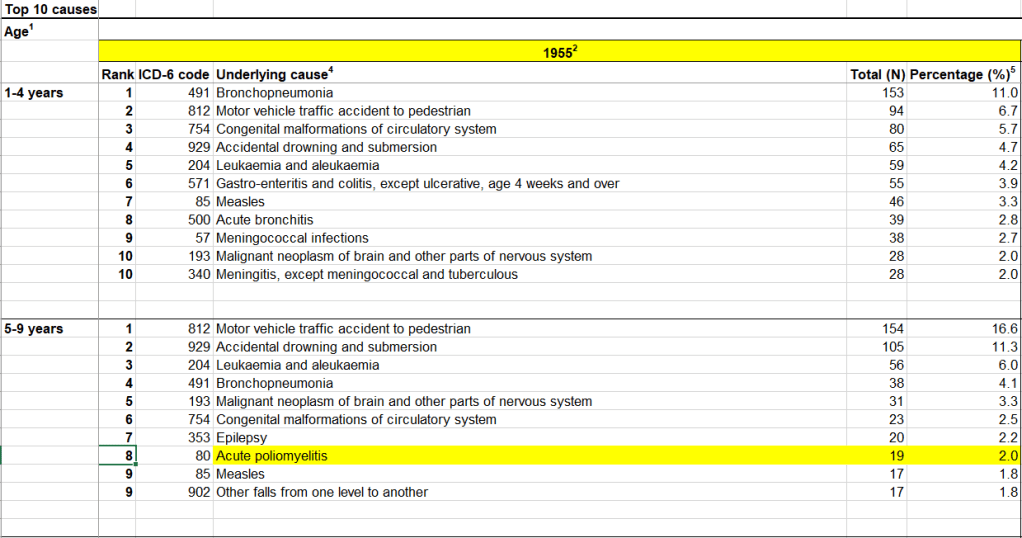
Looking at the ONS data for 1915-2015 in more detail, only in 1955 in 5-9 year olds did polio reach the top 10 causes of deaths. This is the year when a huge epidemic was raging in the UK, elsewhere in Europe and in the USA and people were desperate for a vaccine to protect them.
Here’s a bit from the raw data from the ONS page. In yellow I’ve highlighted the year, the total deaths (19 men and 11 women) and percentage (2% for men and 1.7% for women of total deaths) from acute poliomyelitis, that being polio with paralysis.
For men:
For women:
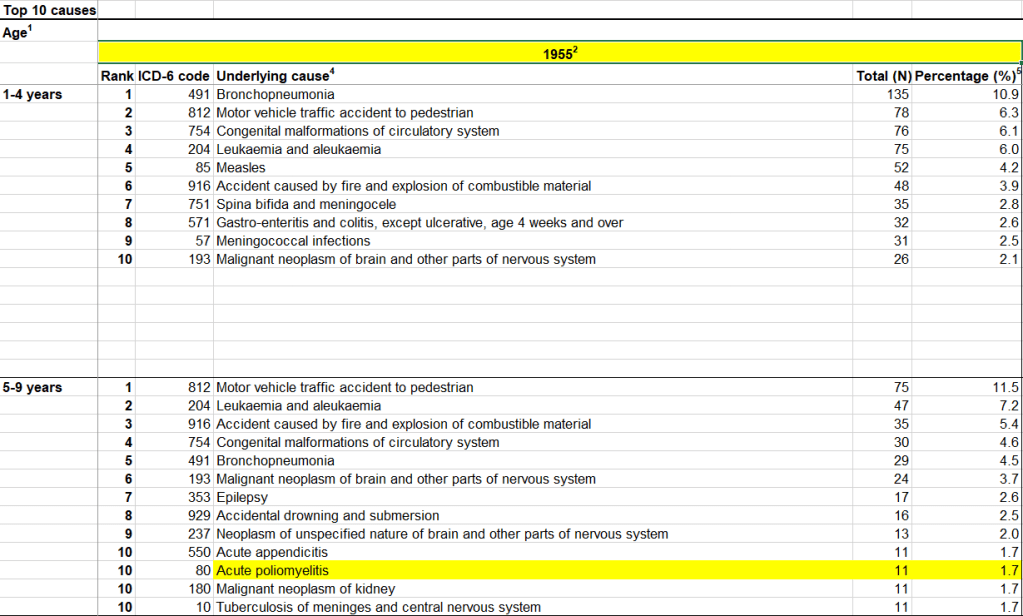
The polio deaths are not as many as measles in 1-4 year olds in 1955 (46 men and 52 women), but in both cases it’s not only deaths that are the public health problem caused by these diseases, it’s also the disabilities that they leave many sufferers with that is of concern…
Paralysis due to polio
Polio virus gets into people via the gut, but can then spread to nerves. One in 200 infections leads to irreversible paralysis (usually in the legs). Among those paralysed, 5–10% die when their breathing muscles become immobilized.
So if everyone in a school of about 200 children got infected polio (and it is very infectious, that was possible) about 1 child in the school would get permanently paralyzed and in 1 in 10 schools a paralyzed child would die.
Most people with a polio infection (99%) actually have no symptoms or only mild symptoms, so they don’t know that they are infectious. This makes it hard to stop the spread, a bit like COVID-19 where lots of people could still spread the disease even if they had no symptoms.
So, polio may only be in the top 10 killers in the UK 1955 (looking from 1915-2015), but before vaccination was begun (in 1956 in the UK) polio was a cause of great deal of disability. For many paralysis is life-long and even milder disease can result in the emergence of post-polio syndrome (PPS) symptoms decades later. The British Polio Fellowship have lots of helpful information about PPS if you’re worried that this may affect you.
For further information, check out an excellent WHO leaflet about polio and the international eradication effort.
There’s also an interesting time-line about the history of polio and the eradication effort here:
 Dr Anne Bishop
Leave a comment