I am delighted to be finding partners and seeking funding for the “Polio Witness Project”, inspired by the stories of polio survivors around the world and the incredible scientific and public health progress that is pushing us towards world-wide polio eradication.
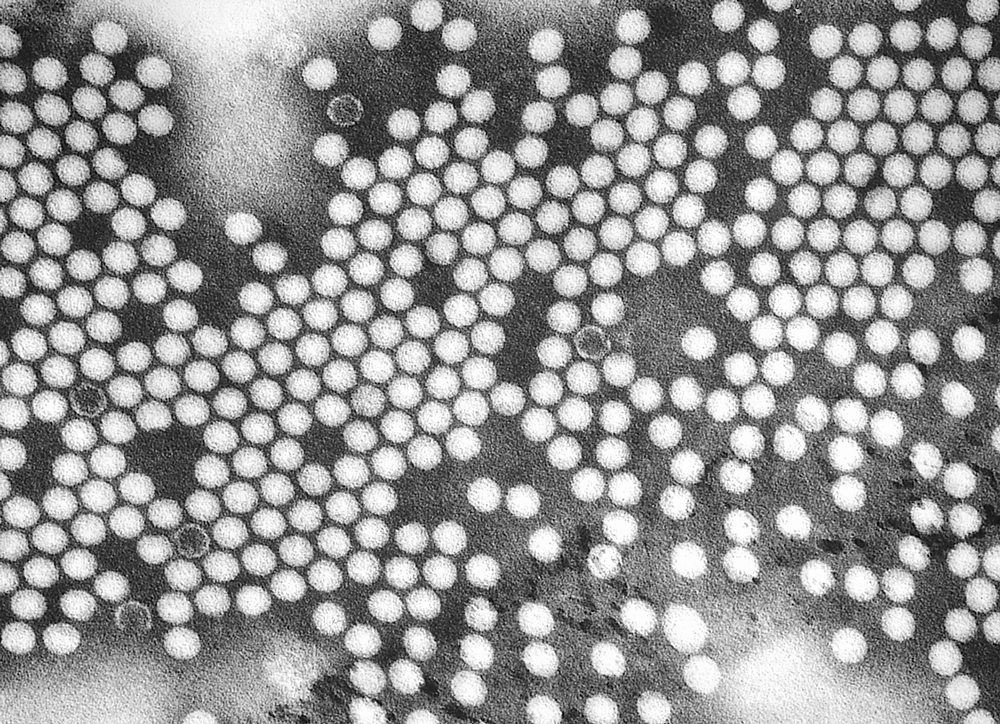
Electron micrograph of the poliovirus.
Public domain https://picryl.com/media/polio-em-phil-1875-lores-b212f9
The project
We plan to collect “witness” recollections from older people in the UK who experience the impact of polio as children, and immigrants to the UK who experienced polio abroad, as well as amplifying accounts that are already in the public domain and raising awareness of post-polio syndrome, which can hit people decades after being first infected with the virus. We will document and archive these stories then bring them to inter-generational workshops with families, where we’ll engage them in activities around lived polio history and the role of vaccines in the global attempt at polio eradication.
Why me and why polio?
My father’s cousin, our “Uncle Roy”, was a polio survivor. He had a short leg, whose growth had been stunted due to polio nerve damage. He wore a shoe with a 2 inch platform on his right foot. He struggle valiantly against mobility limitations all his life.
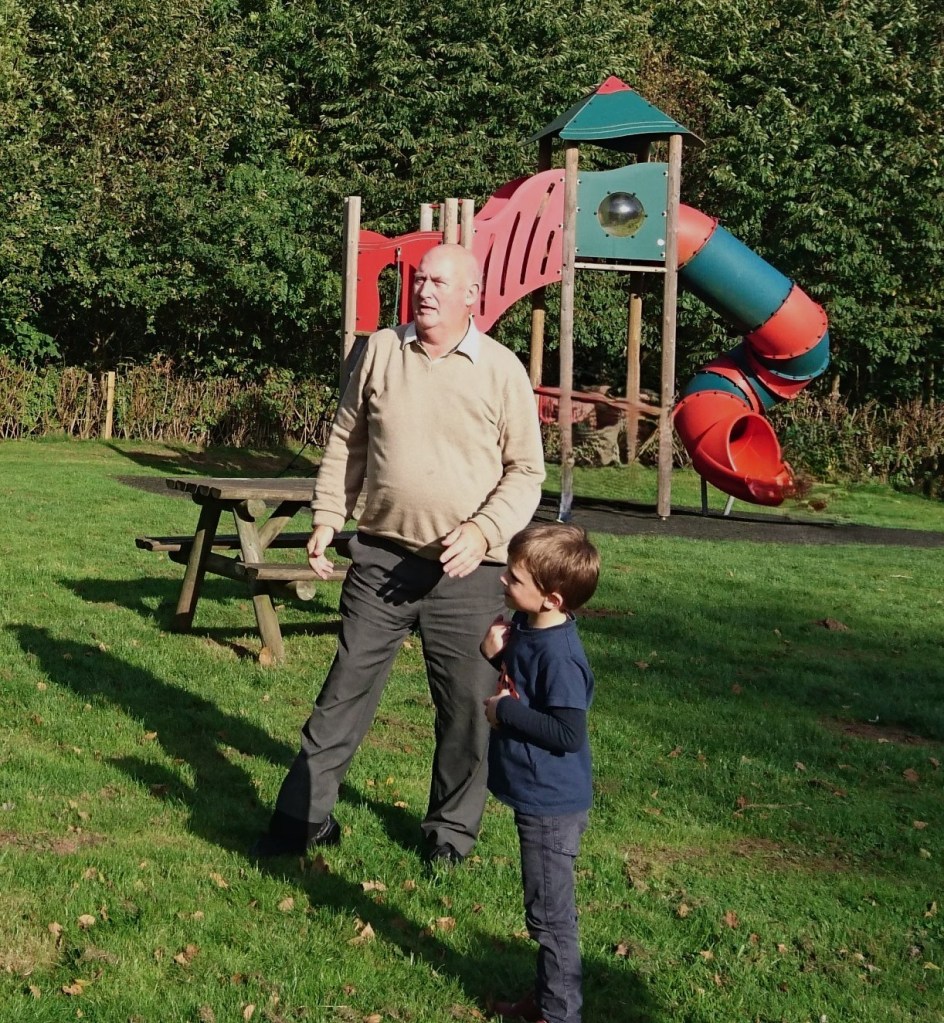
“Uncle” Roy with my son in 2017
After Roy died in 2022 it felt ridiculous that I’d not talked to him more about his experiences of living with the impact of polio and documented his memories. He hated to make a fuss! My Dad is now preparing an account of Roy’s battle with polio and resilience in the face of long-term disability, to add to our “witness” collection of recollections. I don’t want other stories to pass us by.
In my research with bacterial diseases that cause severe diarrhoea, there were many parallels with the spread of polio virus, which it’s also spread through contamination of food or water, or person-to-person contact, with faeces (poo) or spittle from infected people. Polio virus rears its icosahedral-shaped “head” where there is poverty and a lack of infrastructure for clean water, sanitation and vaccination, or break-down of that infrastructure during wars or natural disasters. This is much like the bacterial diseases my research career has focused upon, particularly cholera.
Polio is close to eradication, which represents the power of science, public health, international human innovation and cooperation, and the balancing of risk of disease vs vaccination, which I’m excited to discuss with others.
Why Now?
2026 marks the 70th anniversary of the first polio vaccine roll-out in the UK. If we wait too long polio witness reminiscences will be lost into the mists of time.
Wild polio is only present now in Afghanistan and Pakistan and eradication seems possible, spear-headed by the Global Polio Eradication Initiative and Rotary International.
I have a passion for, and a great deal of experience in, for public engagement and am now making that my focus.
Project partners
I’m excited to use local history sources to investigate polio impact in the UK around 1956 when the vaccine was rolled-out. I’ve started looking into local history archives. Check out my blog “Delving into local polio history“.
I am coordinating with Rotary International, founders of the Global polio eradication initiative, The British Polio Fellowship and the Polio Survivor Network – whose website says “We need your help to educate everyone about polio and post-polio syndrome” and I hope to help them with that aim.
I have the support of Nottingham Trent University oral histories expert Dr Verusca Calabria.
I have been inspired by powerful stories from immigrant polio survivors in the UK, such as paralypians Ade Adepitan (Rotary International champion, writer and TV presenter) and Anne Wafula Strike MBE (speaker, author and inclusion campaigner). I would like to amplify their voices and that of polio survivors documented by the Polio Survivor Network.
More polio information…
These are exciting times for the polio eradication effort!
“In 1988, the World Health Assembly adopted a resolution for the worldwide eradication of polio, marking the launch of the Global Polio Eradication Initiative (GPEI), spearheaded by national governments, World Health Organization (WHO), Rotary International, the US Centers for Disease Control and Prevention (CDC) and UNICEF, and later joined by the Bill & Melinda Gates Foundation and Gavi, the Vaccine Alliance. Since then, the incidence of polio worldwide has been reduced by 99%, and the world stands on the threshold of eradicating a human disease globally for only the second time in history, after smallpox in 1980.” https://www.who.int/news-room/fact-sheets/detail/poliomyelitis
For more information about polio and polio vaccination in the UK, the NHS website polio information is great and the polio section of the Vaccines Knowledge Project is full of helpful facts.
Find out about post-polio syndrome on the NHS website, which has links to British Polio Fellowship resources..
 Dr Anne Bishop
Leave a comment